Tricky cases

Beads no attribute explains, user-defined attributes, and the parsimony rule that arbitrates.

Chapter 4 — Tricky cases & verdict

4.1 · Non-explained beads

Sometimes masking strips a positive bead of all its candidate attributes. SAgA then labels it a non-explained bead and returns no antibody for it. There are two ways to read that:
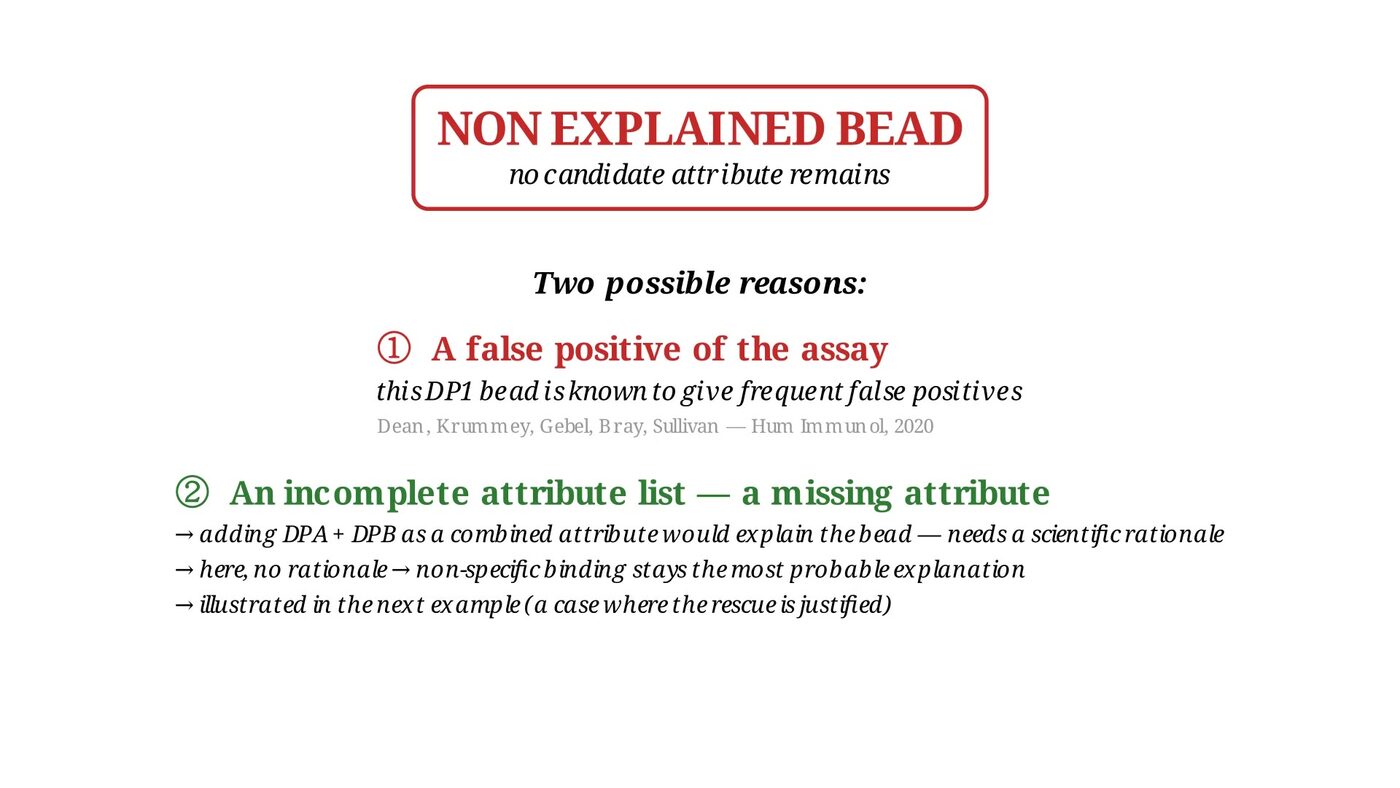
A non-explained bead with its two possible interpretations
A positive bead that has lost every candidate attribute. SAgA returns nothing for it, and leaves the interpretation to you.
  1. A false positive of the assay. Some beads are known to give frequent non-specific binding; here that is the most probable explanation.
  2. An incomplete attribute list. A relevant target may simply be missing from the bead's candidates — which the next section turns into a fix.

4.2 · User-defined attributes

When the standard attributes cannot explain a bead but the literature supports a specific target, you can declare a user-defined attribute. SAgA will take it into account like any other attribute.
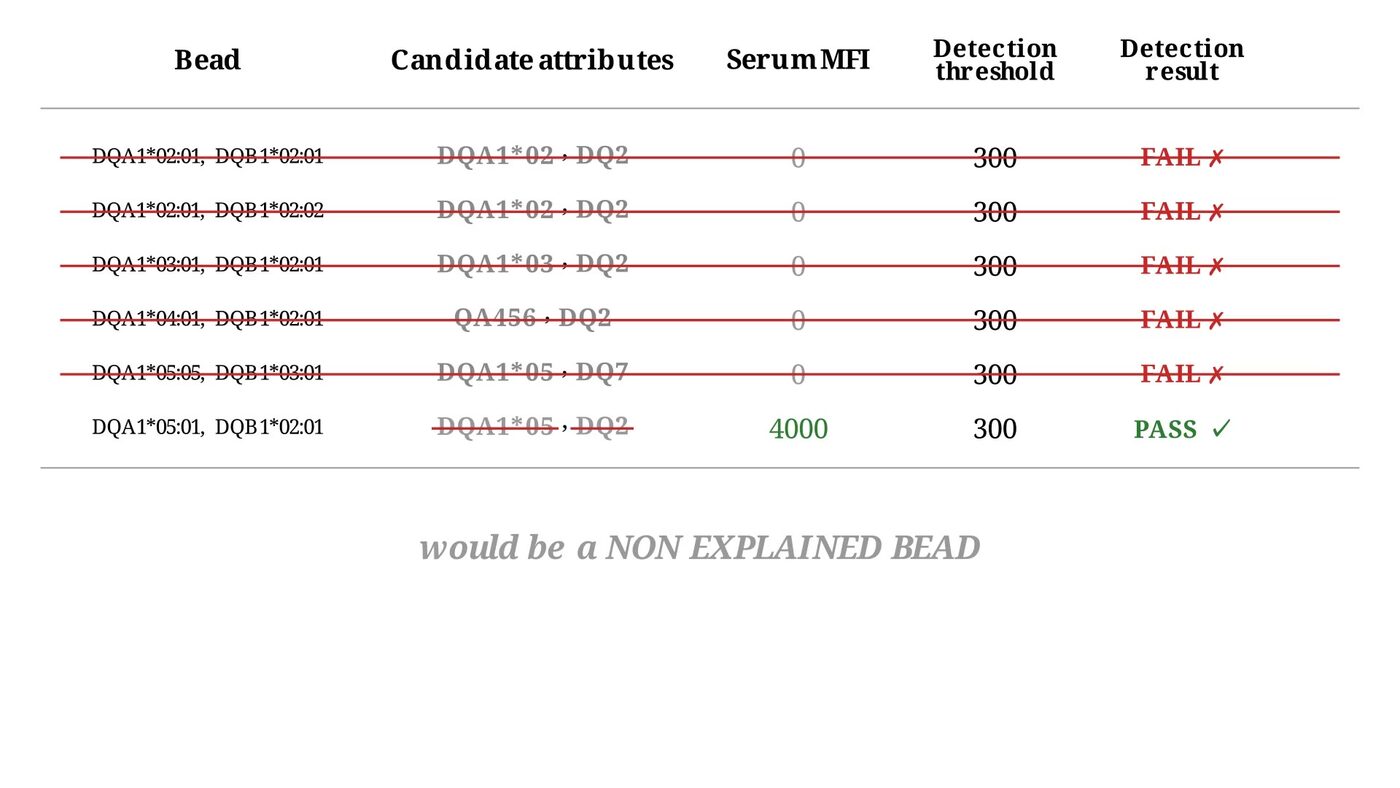
Standard attributes only
All standard attributes are masked by negative beads, leaving the positive bead non-explained
The standard alpha and beta attributes are all carried by negative beads, so they are struck from the positive bead too. With nothing left, it would be flagged as non-explained.
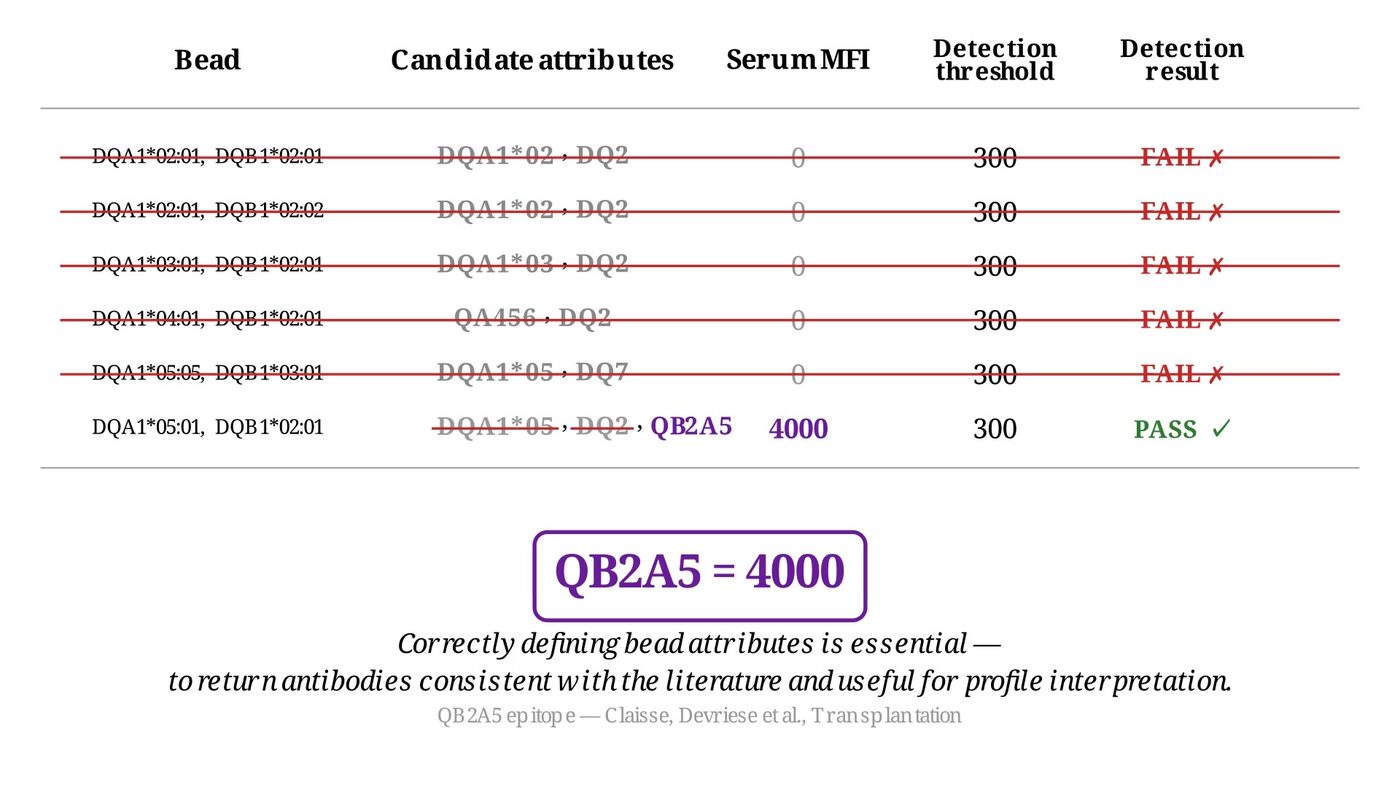
With the user-defined attribute
A user-defined QB2A5 epitope rescues the bead; QB2A5 = 4000 is returned
The user defines QB2A5 (an alpha-beta attribute — the serogroup of the DQ2.5 combination, DQA1*05 + DQB1*02). No single negative bead carries both together, so QB2A5 is unique to the positive bead — its 4000 MFI is assigned to QB2A5 and reported, consistent with the literature.

4.3 · Sparsity

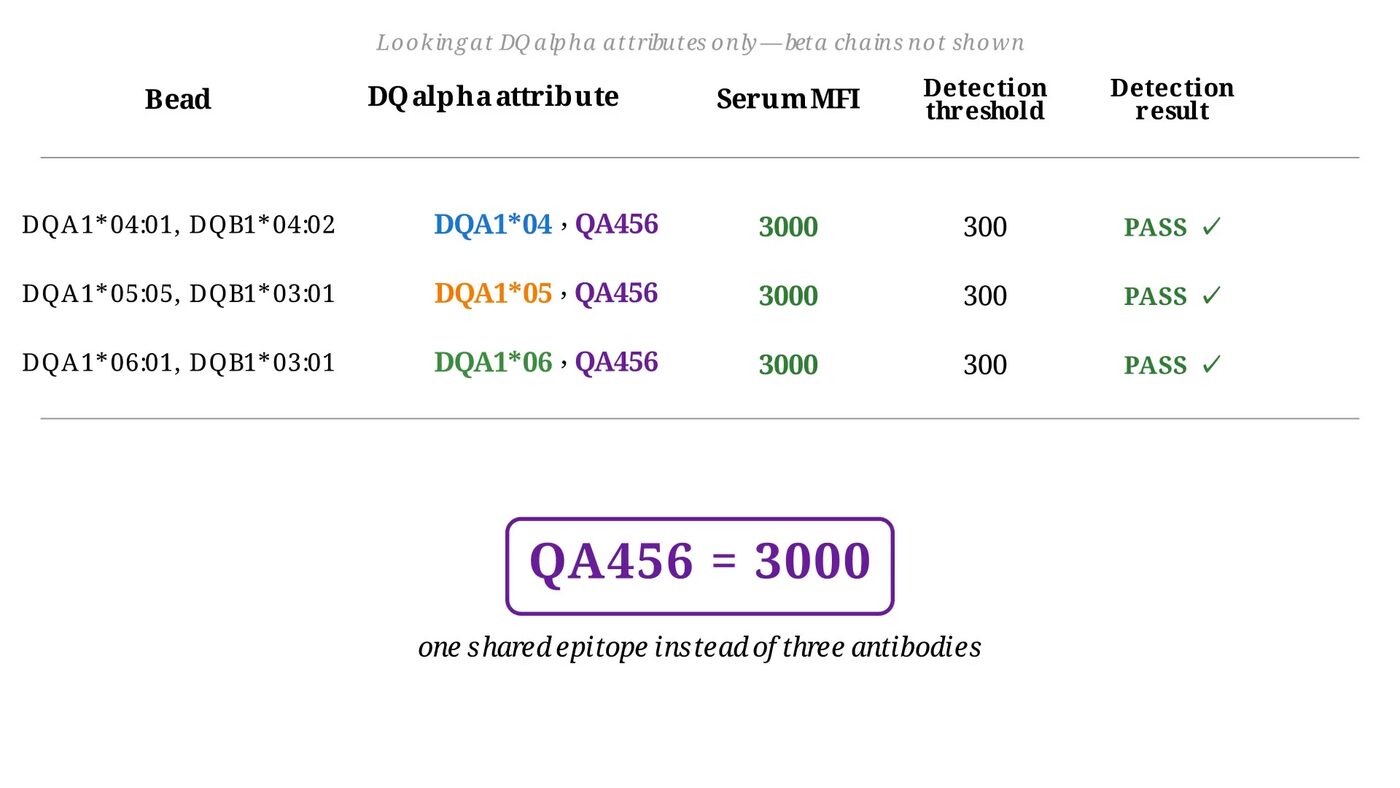
Custom attributes can also let SAgA explain the same signal with fewer antibodies. When two interpretations both fit the data, SAgA is sparse: it returns the solution with the fewest attributes. Of course, you should only add a new attribute when there is scientific justification for creating it.
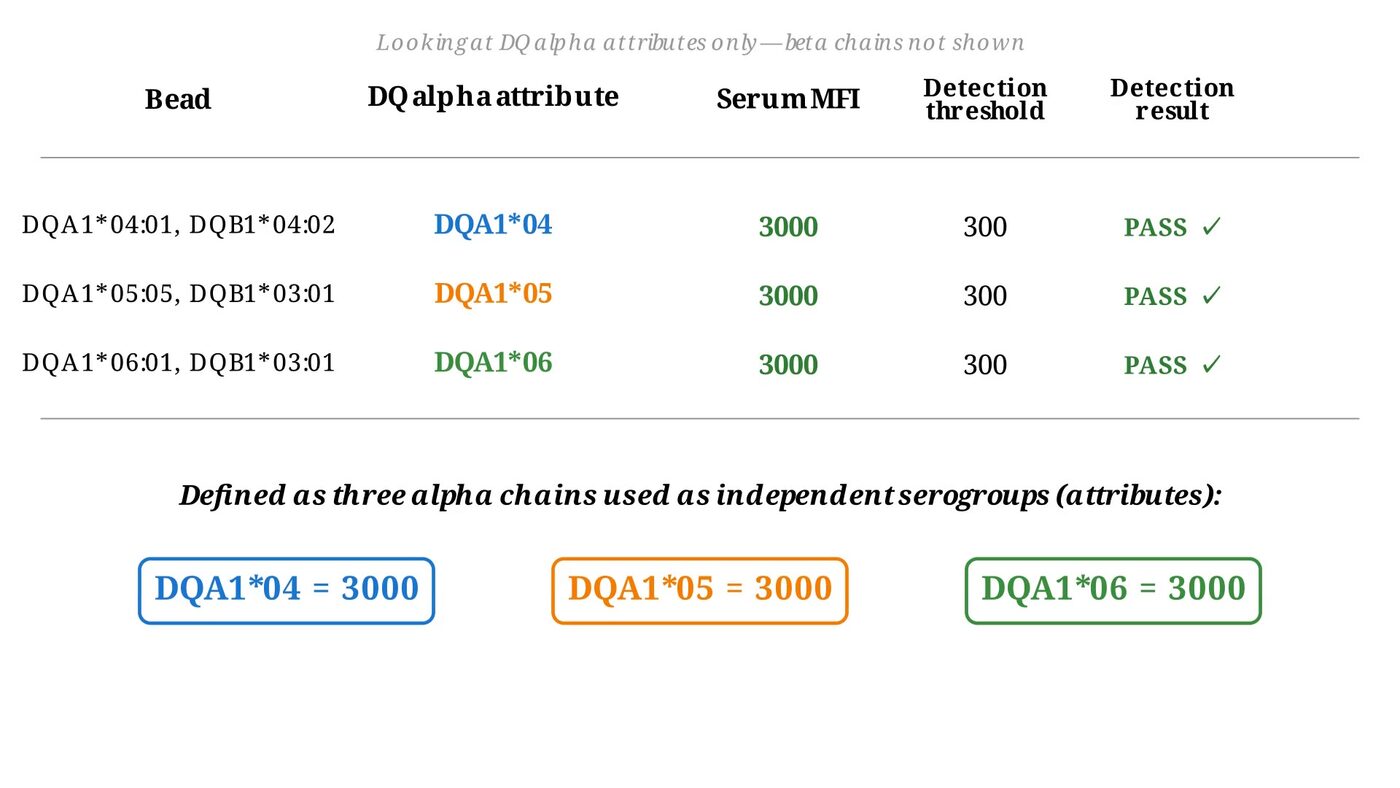
Three independent attributes
Three DQA1 alpha chains defined independently yield three separate antibodies at 3000
Three beads carry three different DQA1 alpha chains (DQA1*04, *05, *06), all reacting at 3000. Defined independently, they yield three separate antibodies.
One shared epitope
Defined as a single shared QA456 epitope, the three collapse into one antibody at 3000
Defined as a single shared epitope QA456, the three collapse into one. Given the choice, SAgA reports a single QA456 antibody at 3000 — the sparser solution.
SiLhoSmart, human-centered software for transplant labs.Legal noticePrivacy© 2026 SiLho®. All rights reserved.