DSA verdict
Confronting the antibodies with the donor's typing, and grading each verdict.
4.4 · The DSA verdict
If you supply the donor's typing, SAgA compares each antibody to it, column by column — the recipient antibody, the donor typing, the donor allele (possibly imputed), and the resulting verdict. The confidence depends on how precisely the donor is typed.
| Antibody vs. donor | Verdict |
|---|---|
| Anti-B*44:02, donor typed high-resolution as B*44:02 → exact target | Certain DSA |
| Anti-B*44:02, donor low-resolution B44 → imputation predicts B*44:02 as most likely, not certain | Probable DSA |
| Anti-B*44:03, donor low-resolution B44 → imputation predicts B*44:02, but B*44:03 remains a possibility, though less (or much less) probable | Possible DSA |
| Anti-B*44:02, donor high-resolution B*44:03 → antibody does not target the donor | Not a DSA |
| Serogroup anti-B44, any B*44 donor (high- or low-resolution) | Certain DSA |
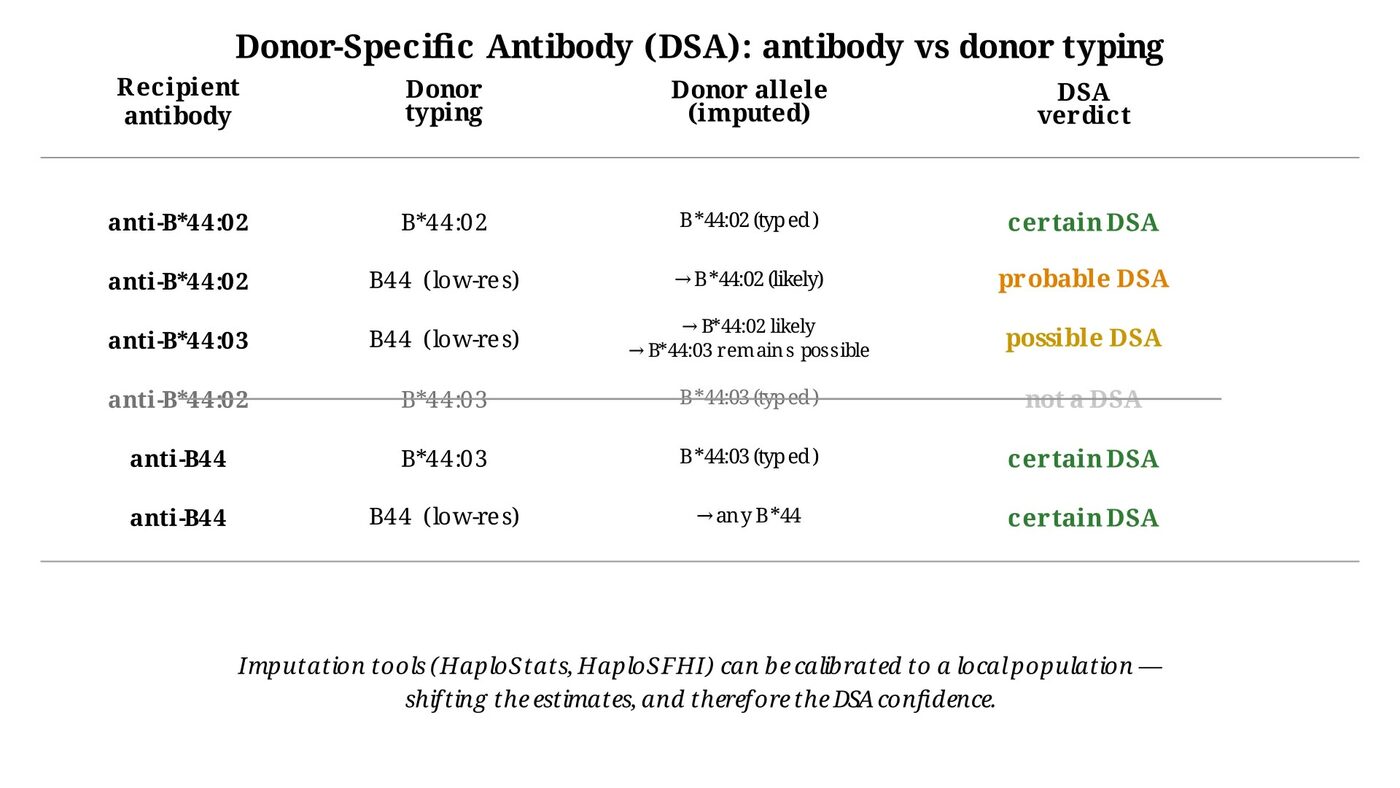
Antibody level matters too. A serogroup-level antibody targets every allele of that group, so anti-B44 is a certain DSA against any B*44 donor — whether typed precisely or not.
The whole pipeline, in one place
- Clean the signal. Adaptive, bead-specific thresholds and per-locus background subtraction separate real signal from noise.
- Decompose each MFI into its own attribute — a serogroup, a serotype, an antigen, an allele, or an epitope.
- Deconvolve overlapping antibodies. When several antibodies hit one bead, SAgA splits the signal between them — its core strength.
- Reach the verdict. A robust best fit carries the analysis through to the donor-specific result.
Throughout, correctly defined attributes are the key: they tell SAgA what each bead can stand for, and shape every antibody returned.
Try SAgA
A demo site is available on request. Write to newaccount@silho.tech to obtain an account, and visit www.silho.tech for more details.
Prefer to watch? The full walk-through is on YouTube.
This manual is a companion to the SAgA presentation video; all figures are stills from that animation.
Cases for this part