Inputs
What you feed SAgA, and what a bead is allowed to represent.
0 · Inputs & the big picture
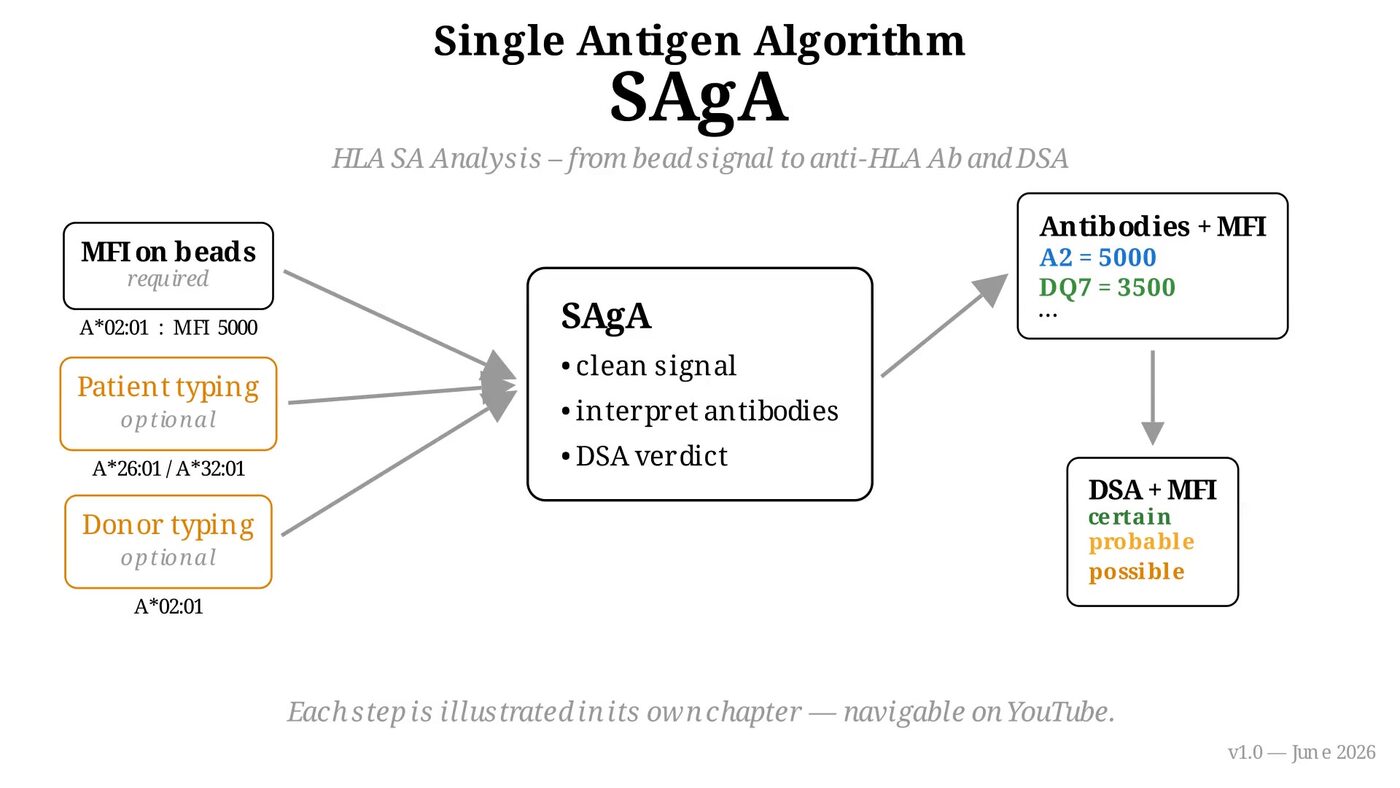
SAgA interprets anti-HLA antibodies measured on Single Antigen assays. Give it the bead readings, and it cleans the signal, works out which antibodies are present, and — if you supply a donor — flags the donor-specific ones. Throughout this manual, the example used is the Luminex Single Antigen assay commercialised by One Lambda (Thermo Fisher Scientific®), a very common one and therefore representative of these assays.
SAgA takes up to three inputs:
- MFI readings on a list of beads — the only required input. Almost any Single Antigen bead list is supported through IMGT database updates.
- The patient's typing — optional, but it improves results by letting SAgA recognise reactivity against the patient's own antigens as noise.
- The donor's typing — optional. This is what unlocks the verdict on donor-specific antibodies (DSA).
How to read the rest of this manual
The sections follow the algorithm's own order: first the signal is cleaned, then each bead is mapped to candidate targets, then antibodies are read out one chapter at a time, and finally the donor comparison produces the verdict.
Attributes: what a bead can stand for
To assign each MFI to a specific antibody, SAgA needs to know, for every bead, its attributes — the potential antibody targets that bead carries. Attributes are user-defined, which is where SAgA's flexibility comes from. The same bead can be described at different levels of detail:
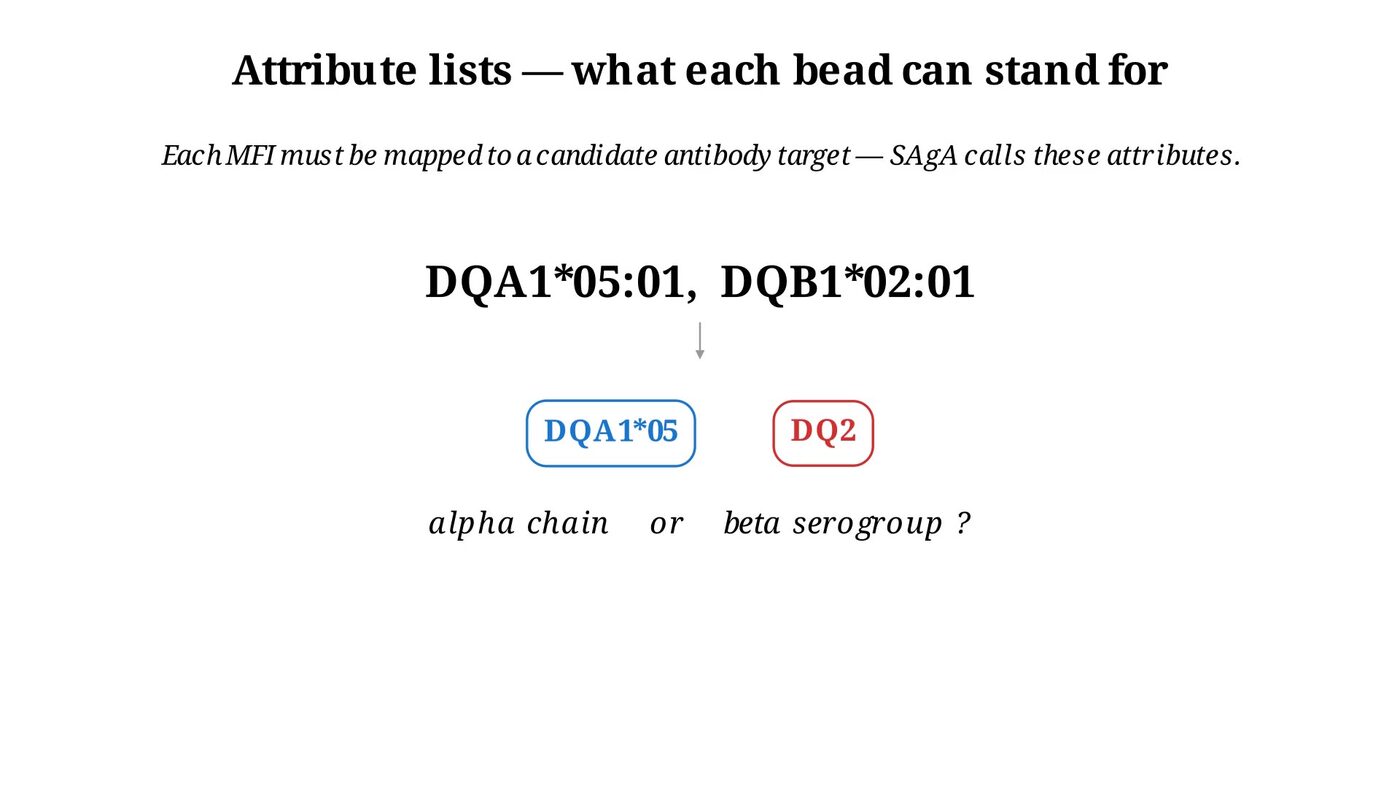
DQ bead — alpha chain and beta serogroup
A DQ molecule pairs two chains, so a DQ bead may be given several candidate attributes: its alpha chain (the DQA1 gene) and its beta serogroup. Assigning them is not mandatory — for some, such as DQ5 or DQ6, the beta serogroup may not be defined, though the DQB alleles are available. Because they pair two chains, DQ (and DP) molecules usually carry more candidate attributes than single-chain ones. SAgA then works out which one the antibody binds.
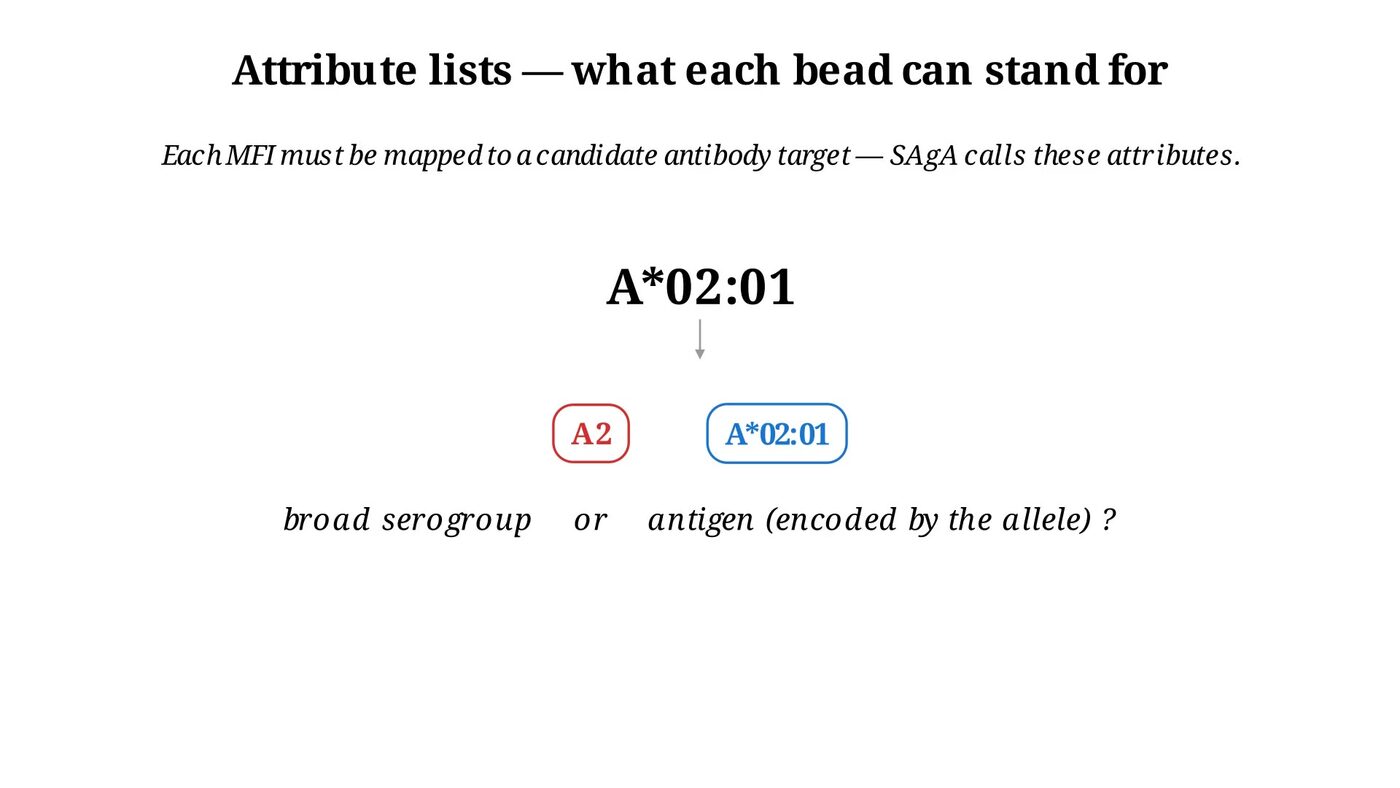
A*02 bead — serogroup or antigen (allele)
A class I bead can be described as a broad serogroup or as the specific antigen encoded by its allele.
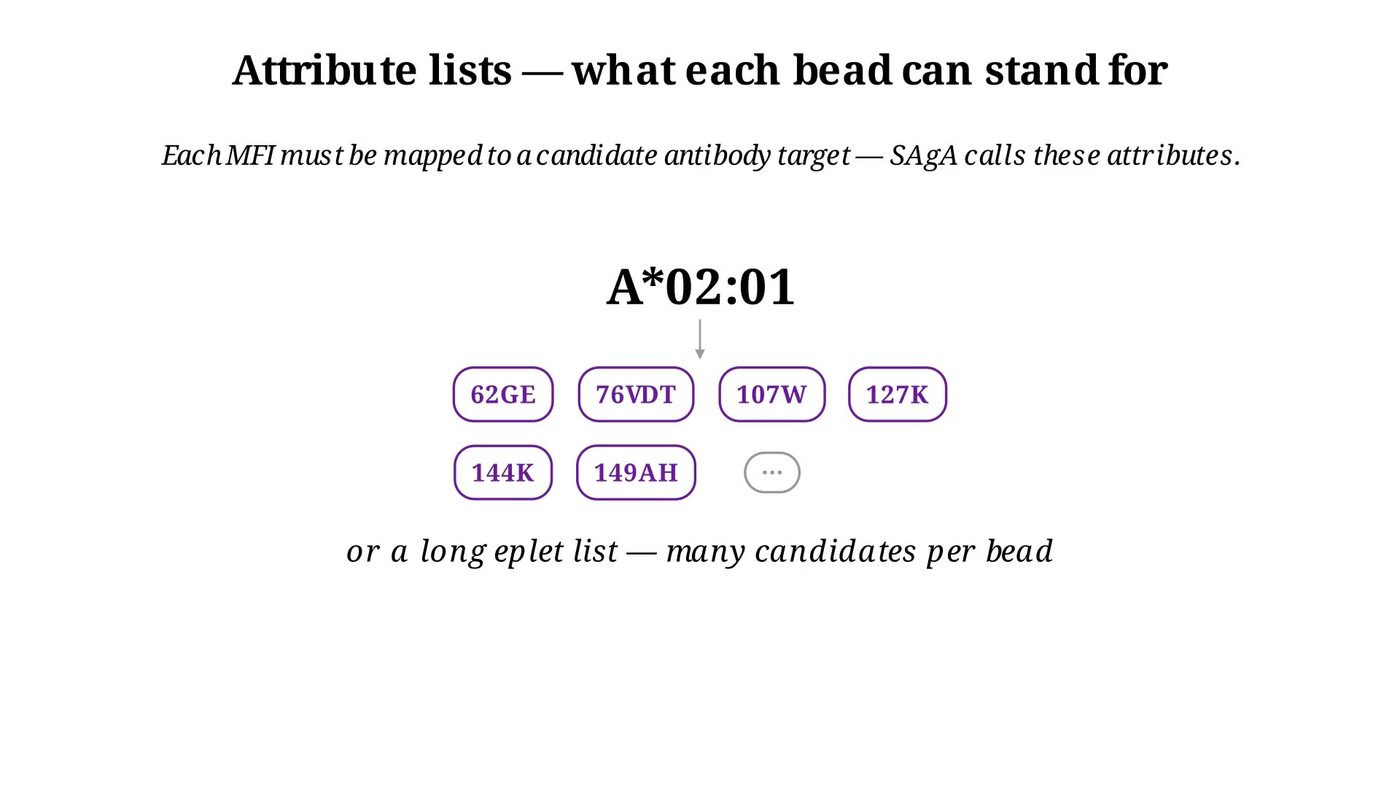
Same A*02 bead — in eplet mode
With an eplet list, the very same bead is instead described by many small motifs, each a potential antibody target — a much finer interpretation, at the cost of more candidates to resolve.
Why this matters
Correctly defined attributes are the most important input you control: they tell SAgA what each bead can represent, and they shape every antibody it returns. The rest of this manual uses short serogroup/antigen lists to keep the examples clear.
Cases for this part