Positivity thresholds
Reading a single bead: detection, positivity, bead-specific thresholds, and setting aside the recipient's own reactivity.
1.1 · Detection & positivity thresholds
SAgA reasons in two stages, controlled by two thresholds (both configurable):
- The detection threshold separates noise from real signal on each bead.
- The positivity threshold then decides whether an attribute is actually returned.
The core rule for a group of beads
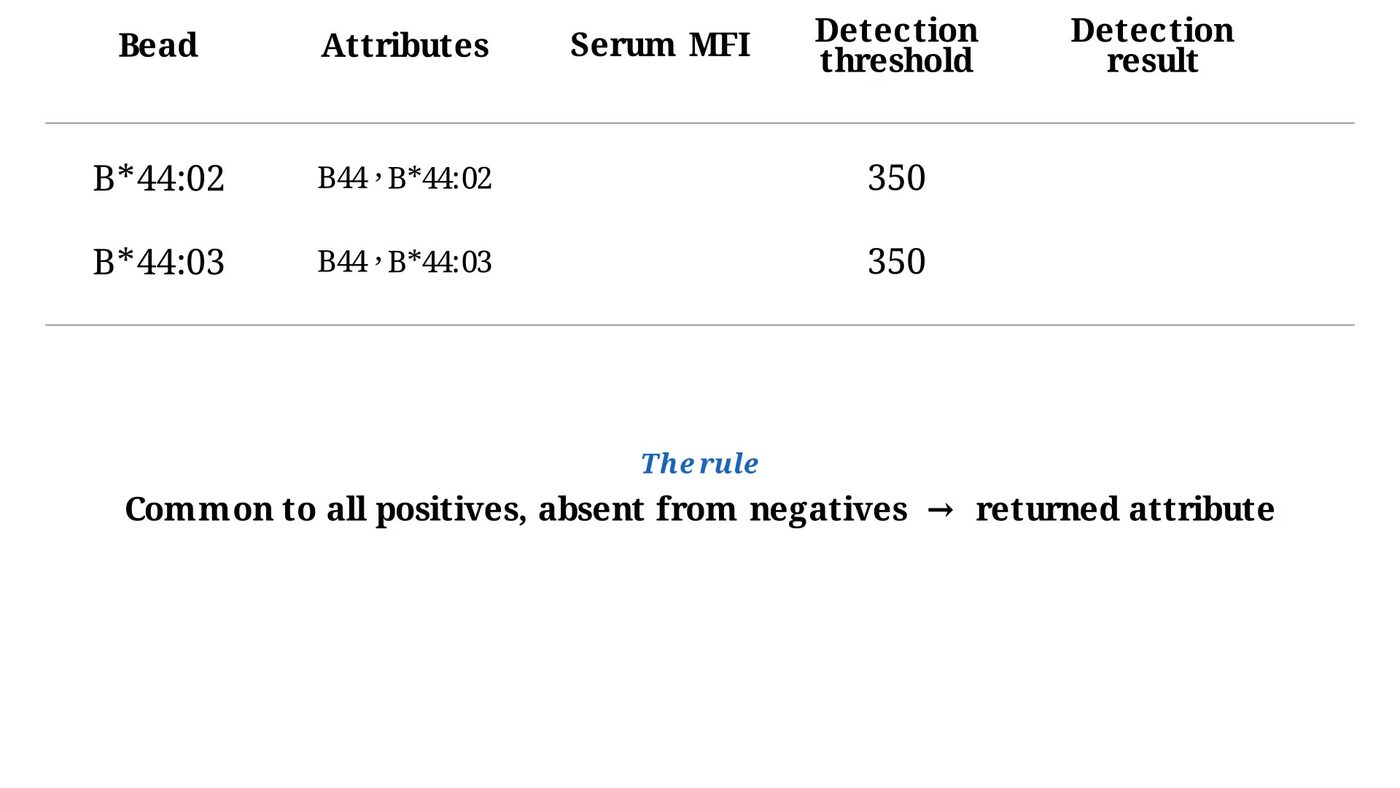
SAgA returns the attribute that is common to all positive beads and absent from the negative ones. When several beads share the same antibody, their MFI are averaged — but every bead must also pass detection on its own.
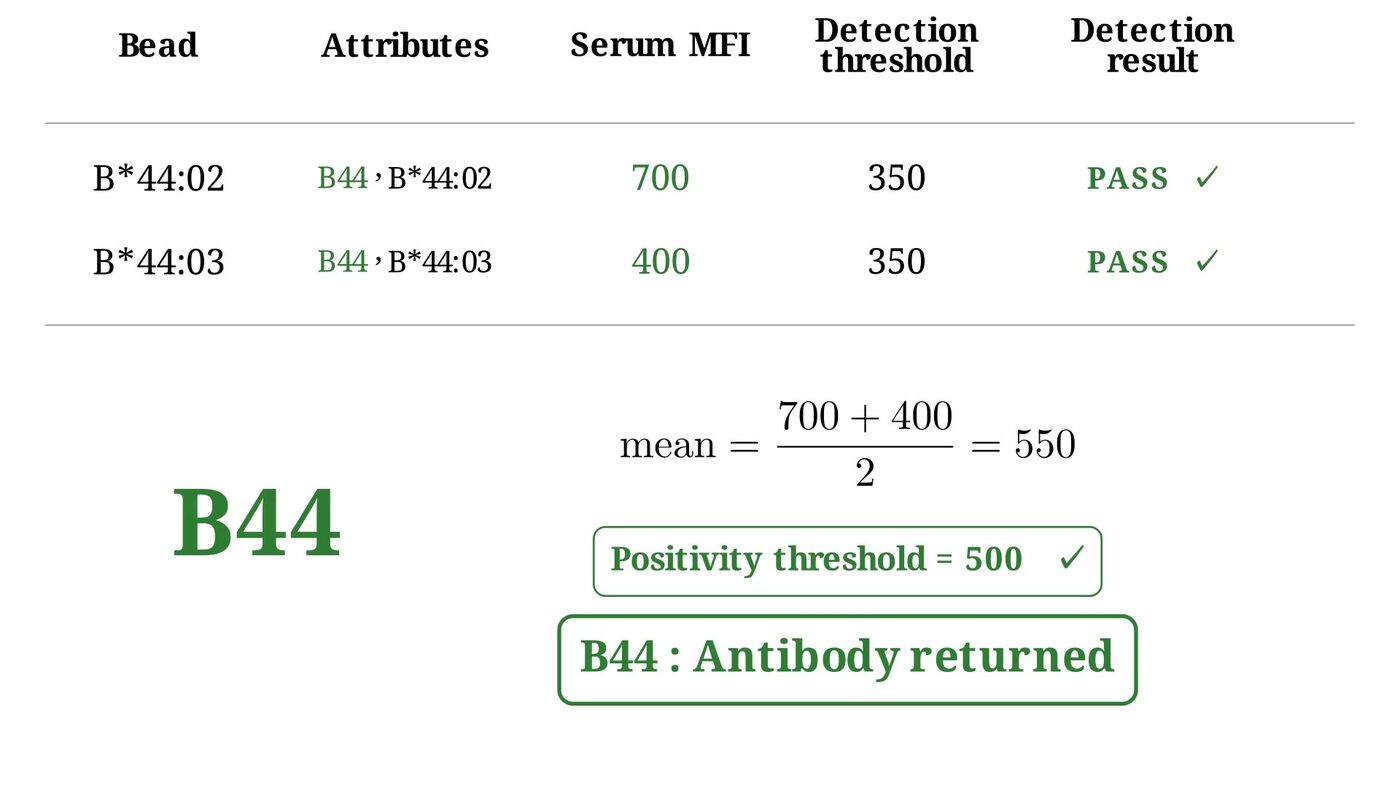
Example 1 · Both beads clearly positive → serogroup
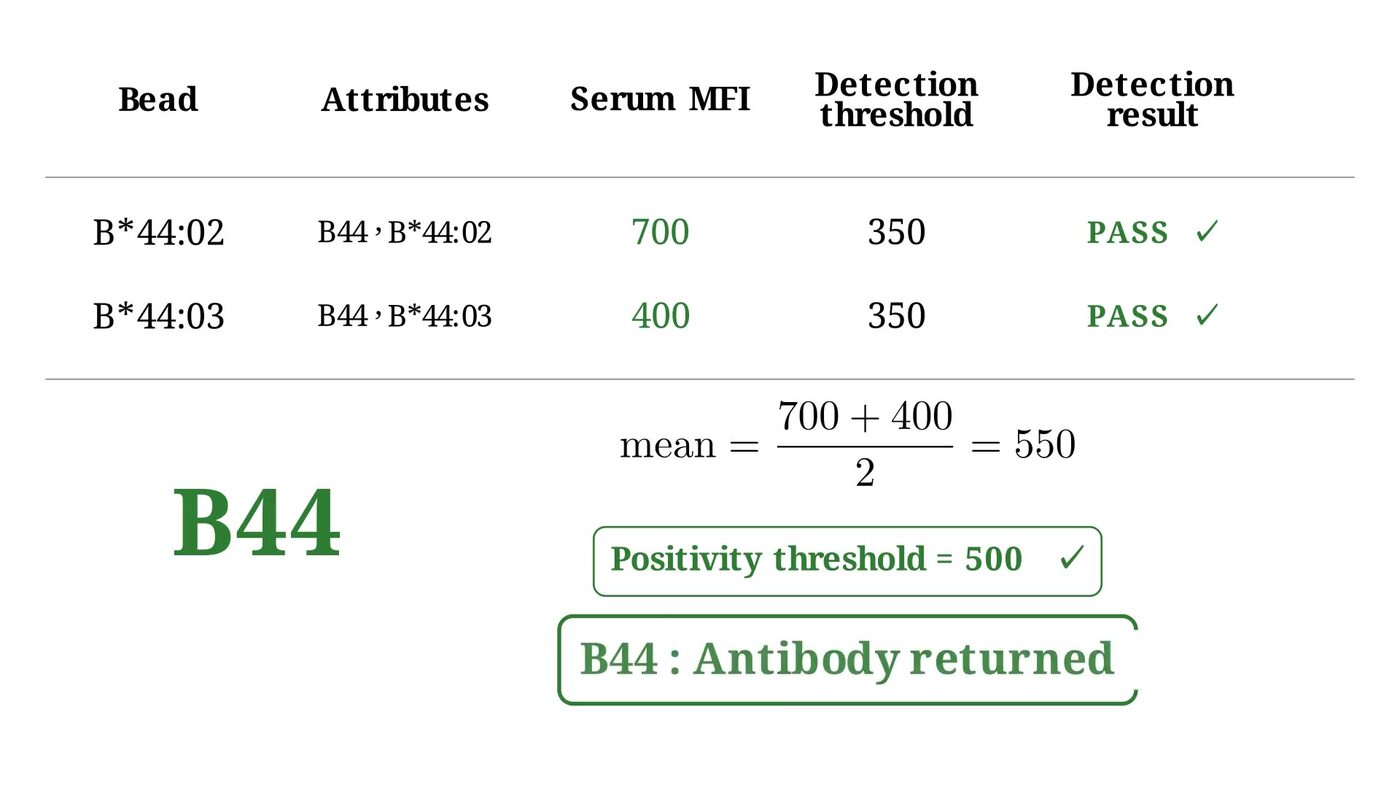
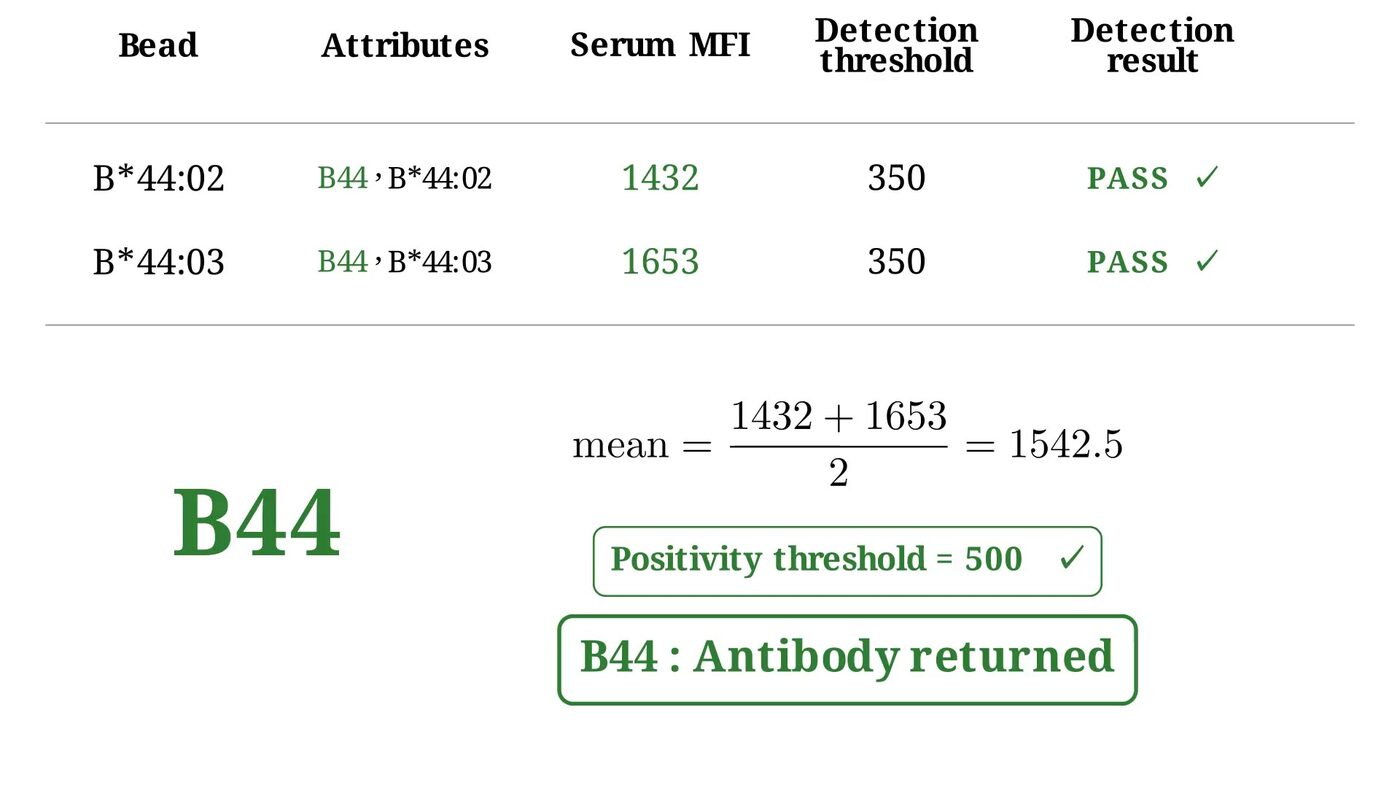
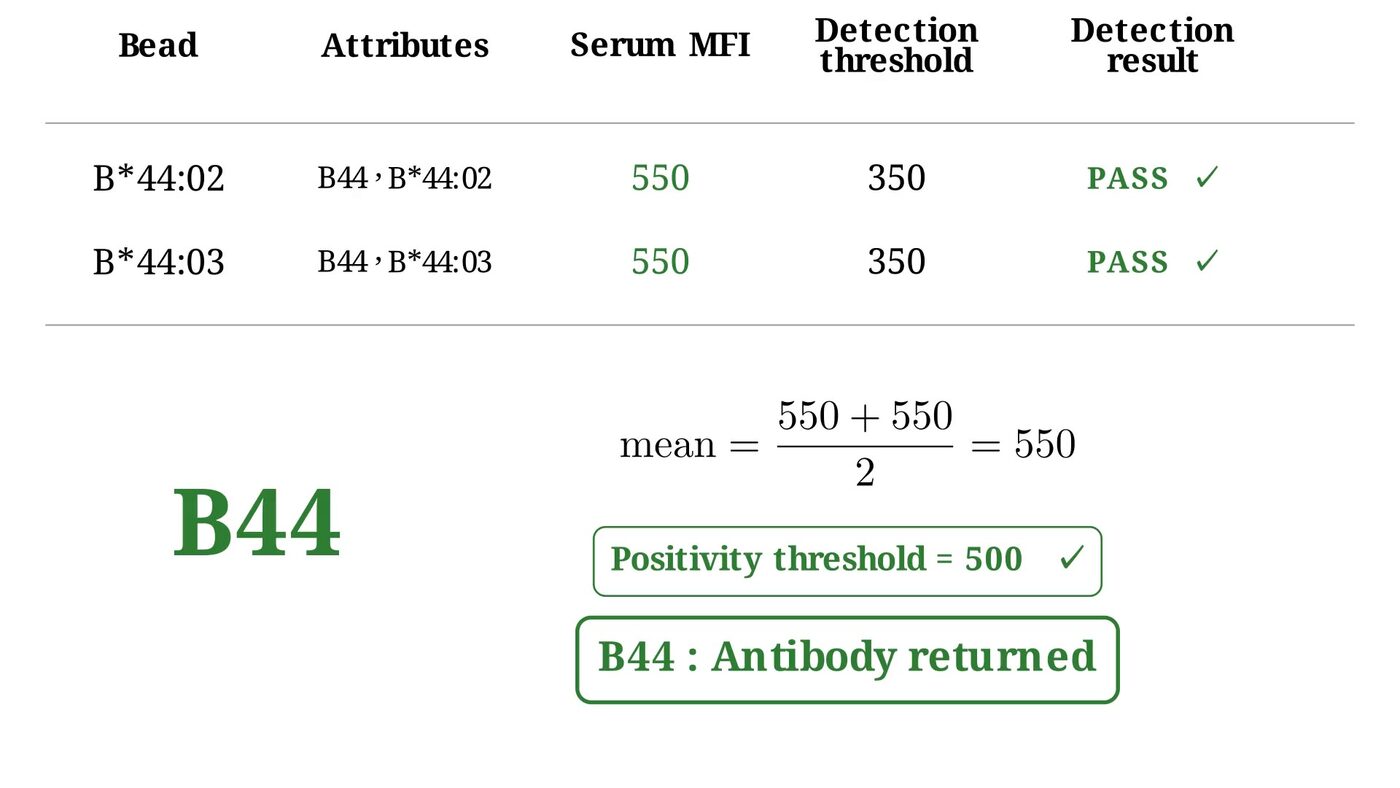
Both B44 beads sit well above detection, and their average clears the positivity threshold with room to spare. SAgA returns the shared serogroup B44.
Example 2 · One strong, one mild → still the serogroup
One bead is strong, the other only mildly positive. Both still pass detection, so both contribute to the average — and at 550 the call remains B44, because the serogroup average absorbs the between-allele variability.
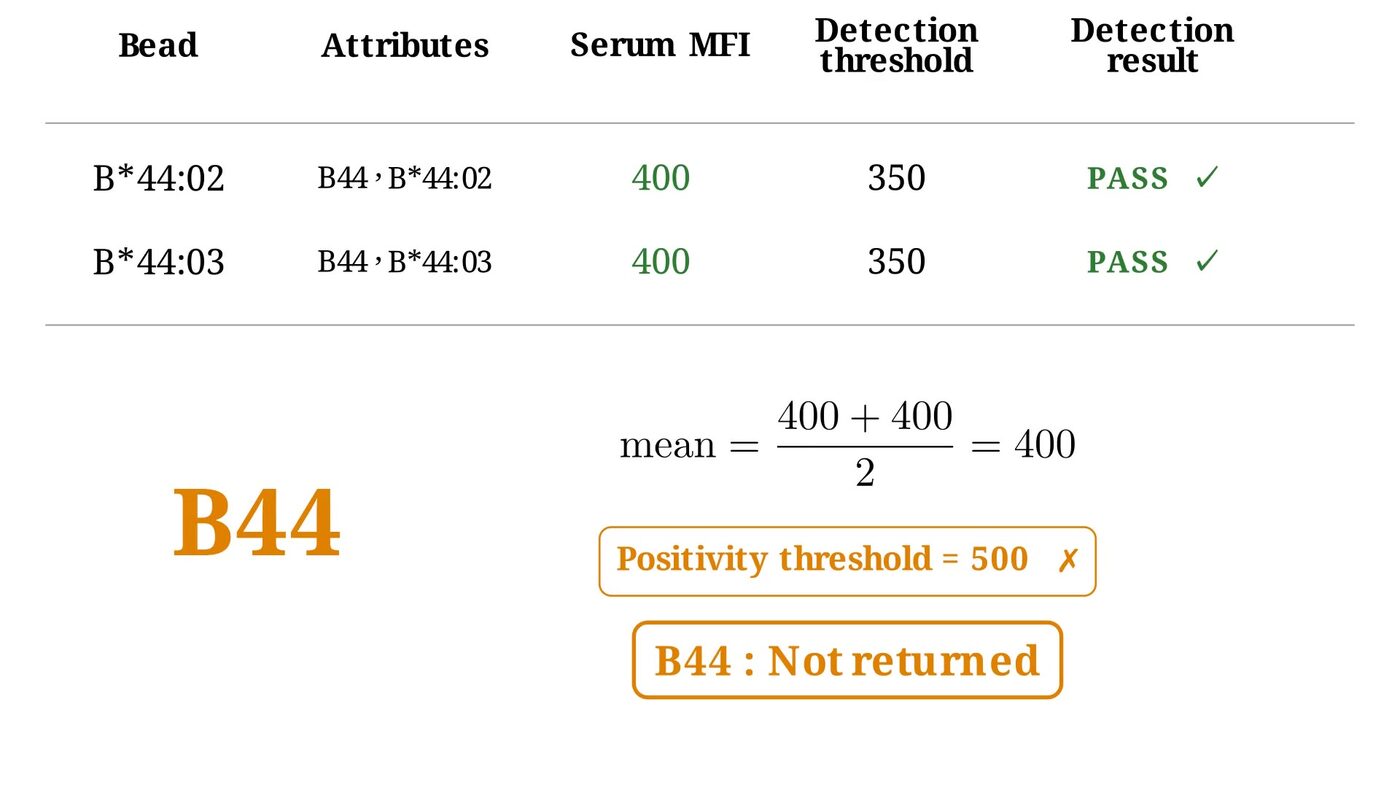
Example 3 · Detected, but below positivity → nothing returned
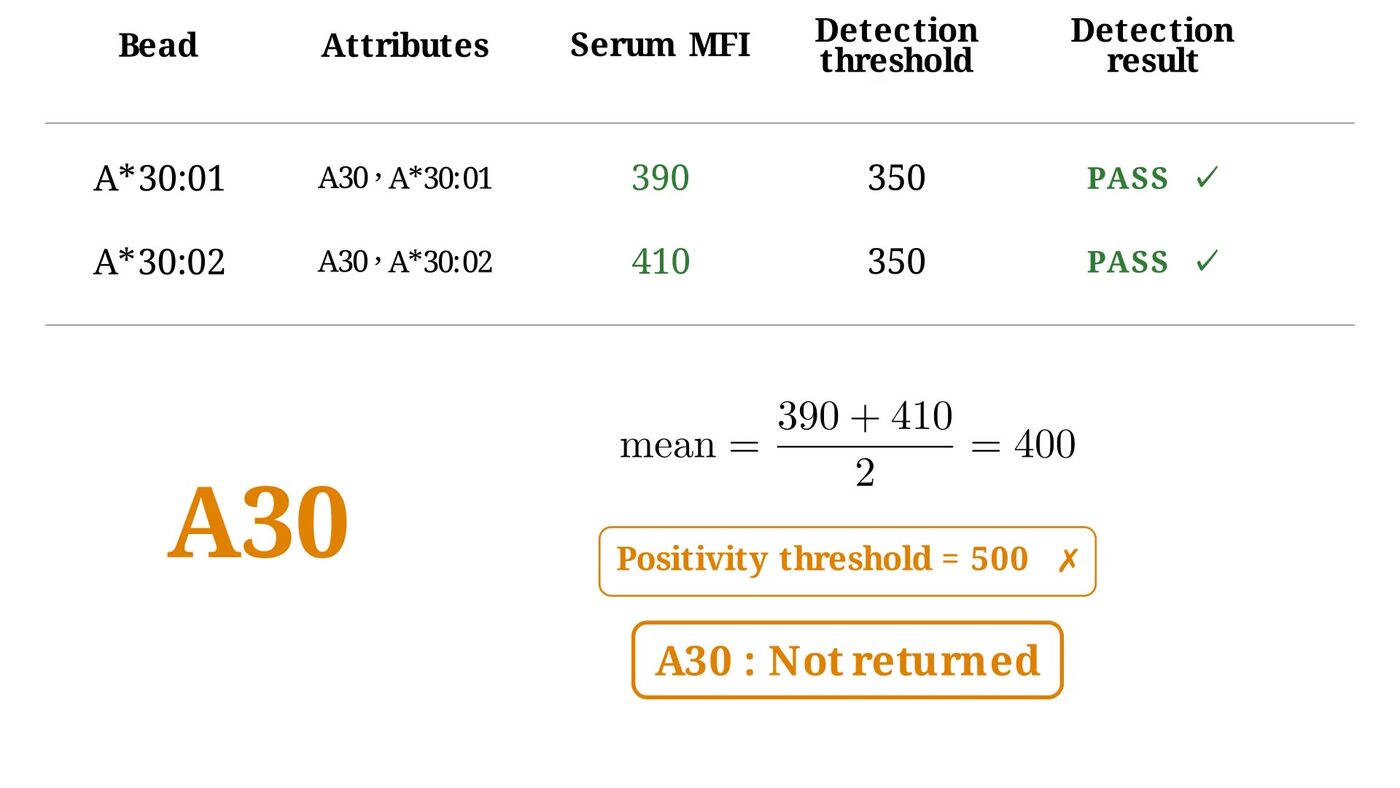
Here both beads pass detection, but their average is only 400 — below the positivity threshold of 500. Detecting a signal is not enough to report an antibody, so SAgA returns nothing.
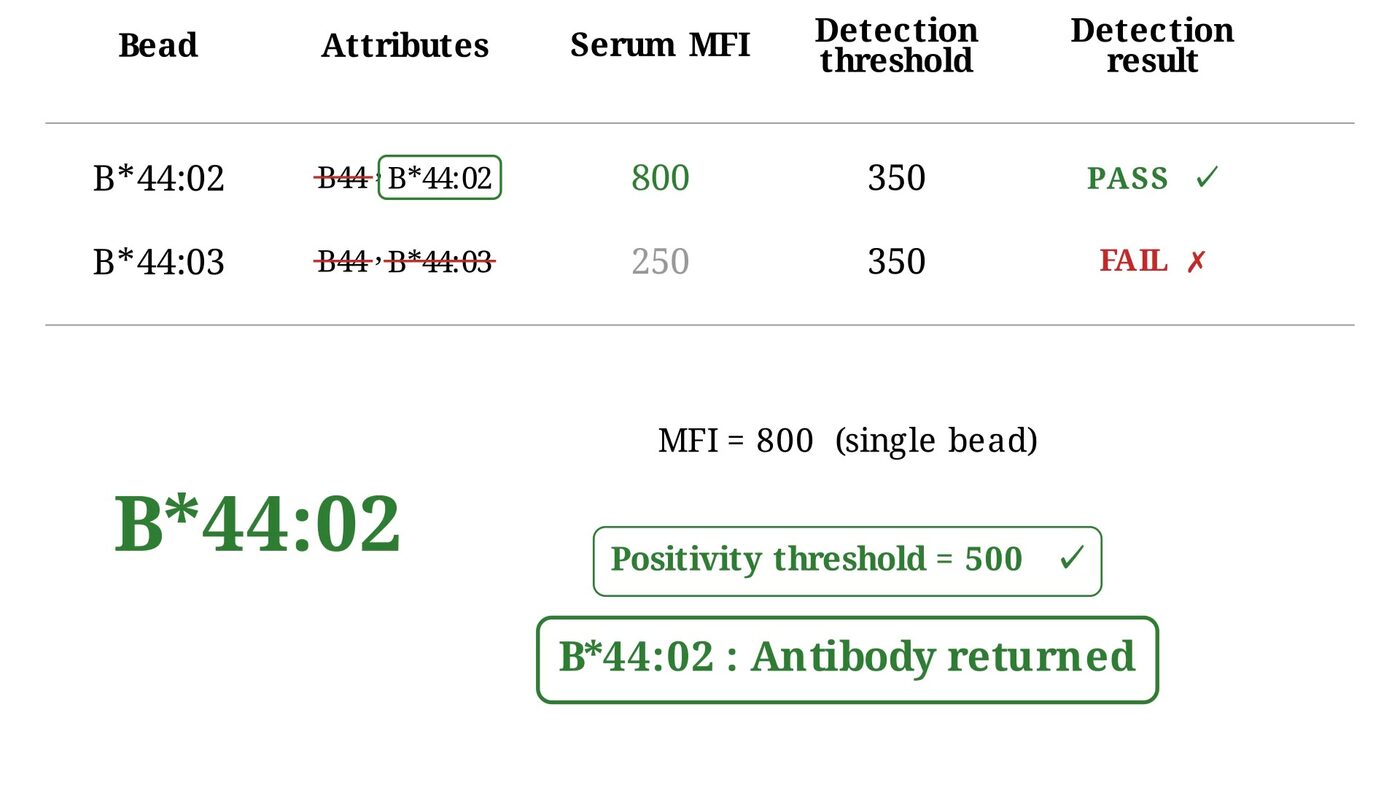
Example 4 · A bead fails detection → antigen survives
Averaging alone is not enough — every bead must also pass detection. When a bead falls below the detection threshold it is struck out, and all the attributes it carries are eliminated, including any serogroup shared with it. Only an antigen unique to the surviving bead can still be returned.
1.2 · Bead-specific thresholds
SAgA can apply a strategy for defining the positivity cut-off of an antibody based on bead-specific thresholds instead of a fixed cut-off (e.g. set at 500 MFI). See Usureau et al., Eur. J. Immunol., 2024.
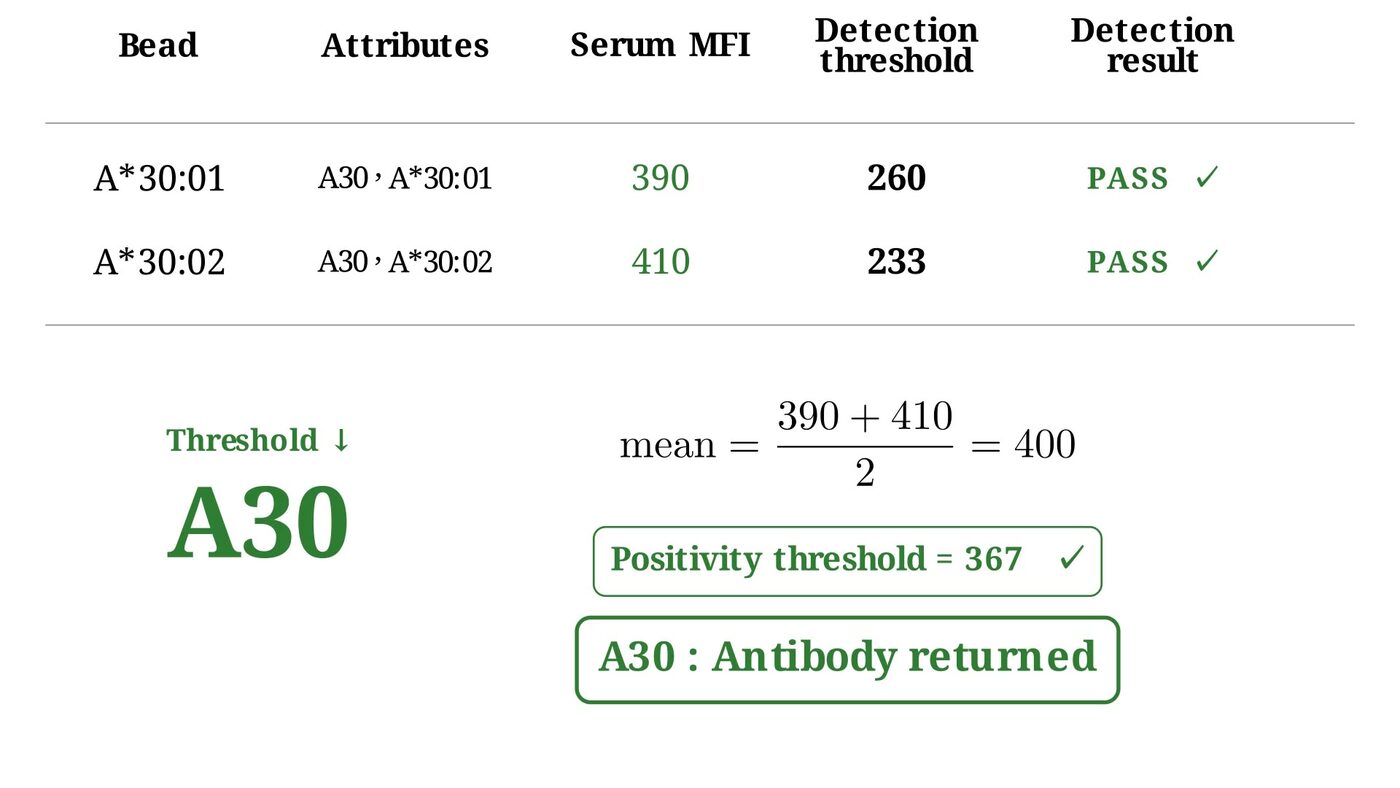
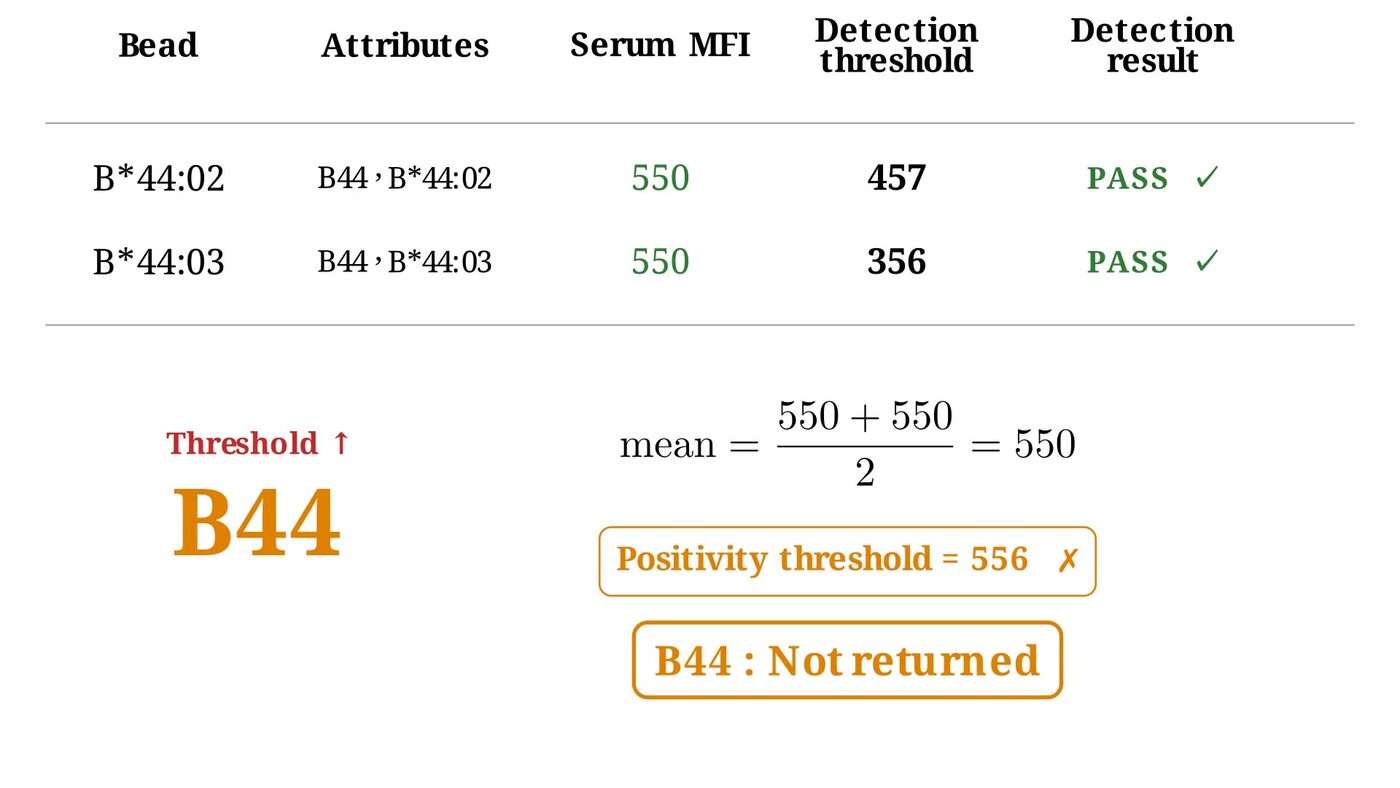
The 350 / 500 defaults are uniform across all beads. SAgA can optionally recalibrate them bead by bead — improving both sensitivity and specificity. You can keep the defaults, or switch this on for finer control, in both directions, upwards or downwards. Recalibration acts on both a per-bead detection threshold and a per-attribute positivity threshold at once.
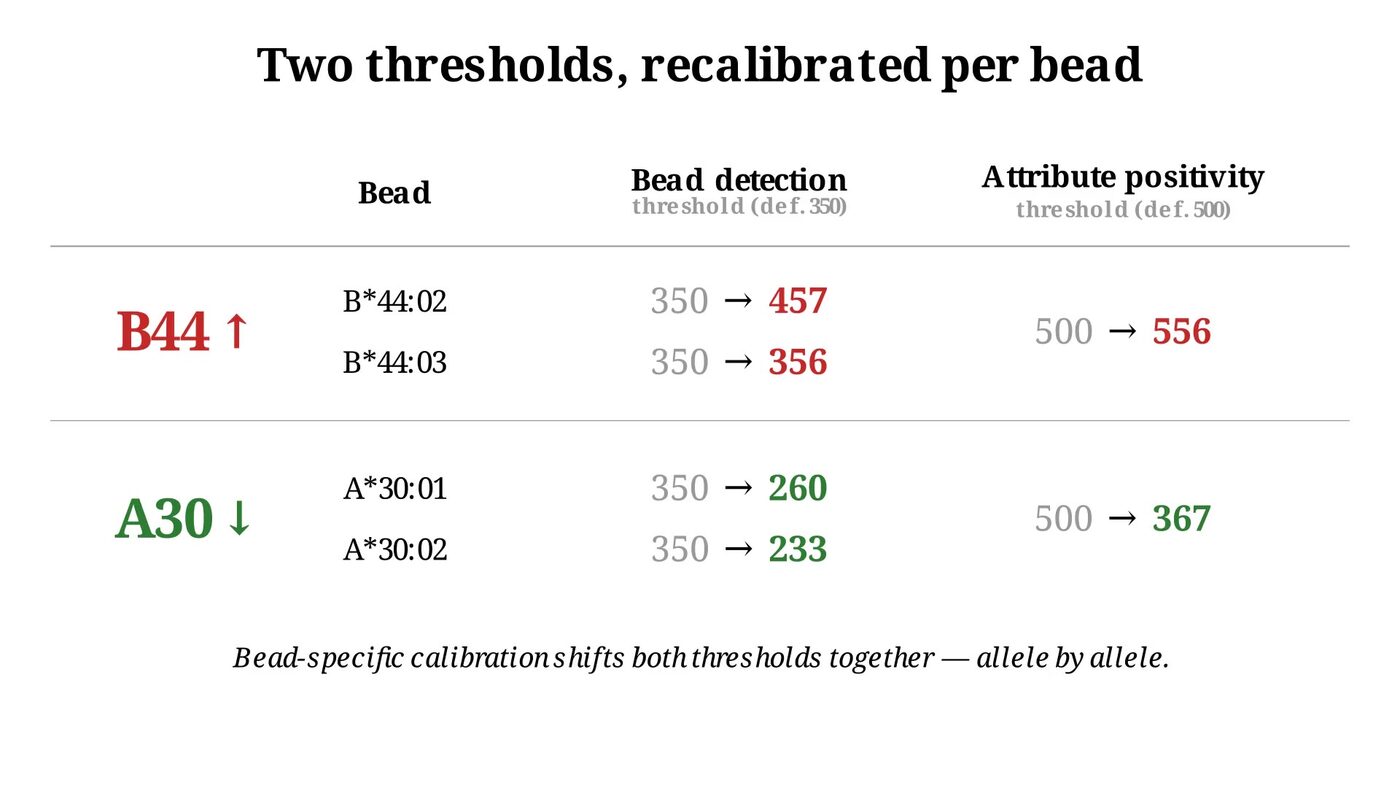
Permissive · lower thresholds recover a weak true positive
Some beads have an intrinsically low background, so an MFI below 500 may already be meaningful. With the default thresholds this A30 signal is discarded; with the calibrated ones it passes.
Stringent · higher thresholds filter a borderline positive
On other beads calibration moves the other way. For B44, raising the thresholds turns a borderline default-positive into a non-call.
1.3 · Self-antibody exclusion
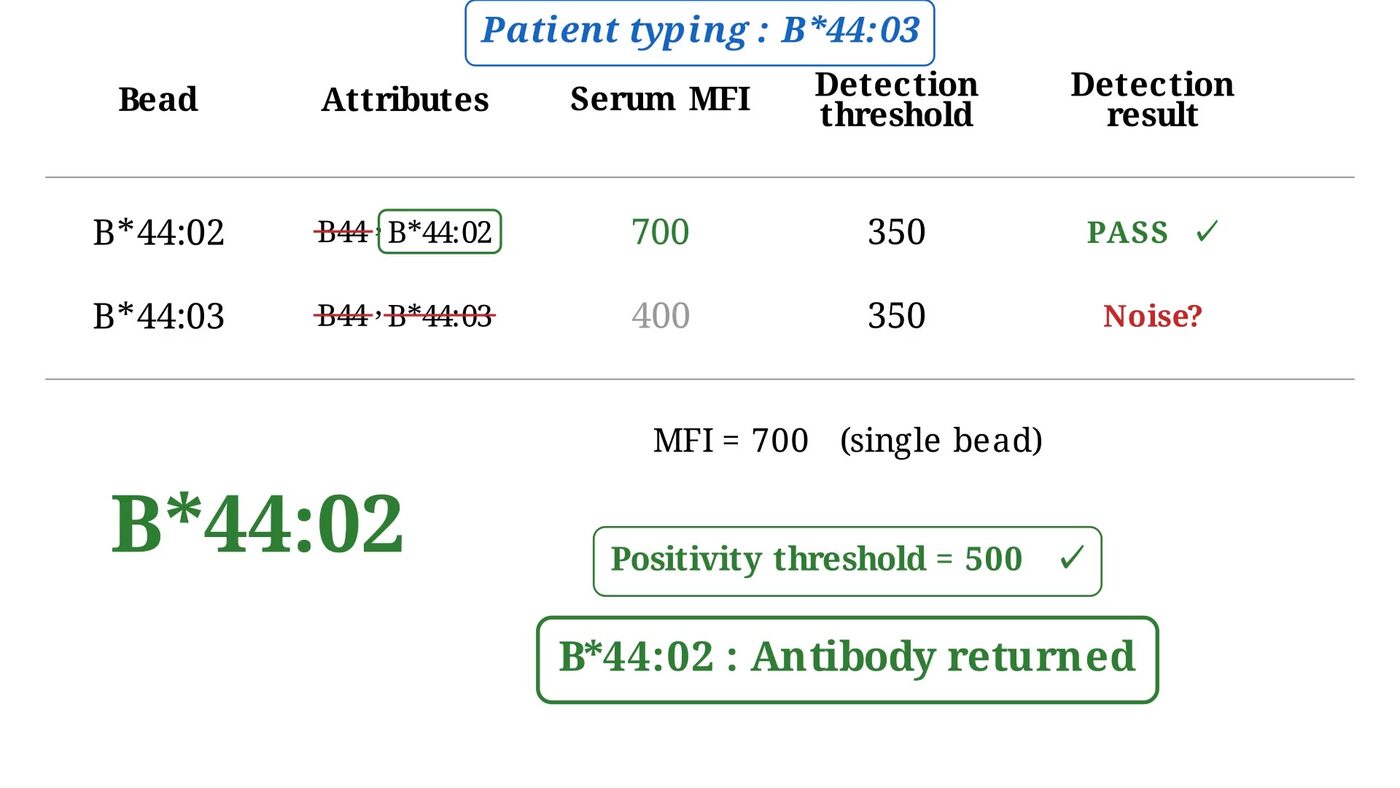
This is where the patient typing earns its place. If a bead matches one of the patient's own antigens, any reactivity on it cannot be a true anti-HLA antibody — it would target self. SAgA flags that row as noise and excludes it from the antibody and DSA result — though the bead was still analysed by SAgA.